
What Is An Across-The-Line Backswing?
It means that the clubhead is pointing to the right of your target at the top of the backswing (for a right-handed player).
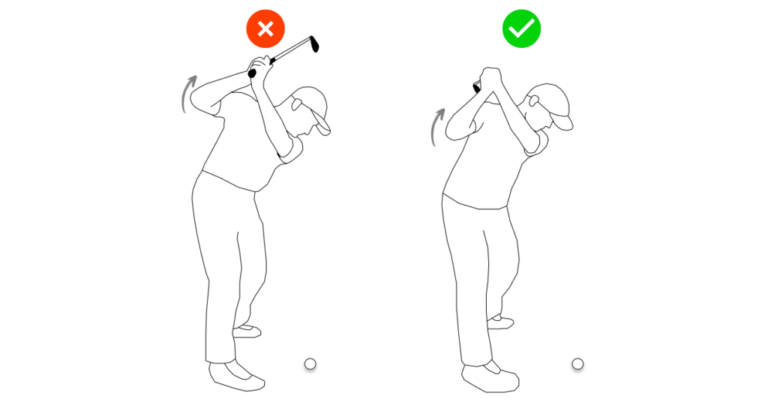
How It Affects Your Golf Shots
- Outside-In Path
This position can throw the club into an over-the-top position, causing pulls and slices. - Timing and Consistency Issues
This position makes the rhythm and timing of the swing inconsistent, which impacts your ball-striking. - Multiple Misses
You can hit the shot in multiple directions as the swing path and clubface at impact are inconsistent.
What Causes An Across-The-Line Backswing?
- Over-Active Hands
Over-active hands in the takeaway can send the club across the line at the top. - Excess Wrist Movement
A cupped or bowed lead wrist can point the shaft in the wrong direction. - Lack of Hip Rotation
When the shoulders rotate and the hips don’t, the arms keep moving and the club goes across the line. - Excess Grip Pressure
An excessively strong grip can make the club point across the line at the top. - Inside Takeaway
It leads to a steep lift with the arms and the club goes across the line. - Early Wrist Roll
Rolling the wrists too soon can put the clubface and shaft out of position. - Long Backswing
Swinging past parallel causes the arms to lose control and the shaft crosses the line. - Lack of Width in the Backswing
A narrow backswing limits space and makes the club go across the target line at the top.
Use GolfWiz’s AI Swing Analysis to pinpoint the exact technical errors holding you back.
What Other Faults Does An Across-The-Line Backswing Cause?
- Club Points Down the Target Line at the Top
At the top of your swing, picture the club shaft being parallel to your target line. - Keep the Shaft Over Your Trail Shoulder
Imagine the shaft sitting right over your trail shoulder. - Short and Wide Swing
Think about making your swing shorter while keeping good width. - Turn Chest, Not Just Arms
Start your backswing by turning your chest, not just moving your arms.
Swing Cues & Feels
Build your pyramid
Feel your feet pressing outward into the ground, creating a wide triangular base. This anchors rotation and prevents swaying.Weight in your heels
Keep 60% pressure in heels at setup and maintain through impact. Avoid rocking forward which narrows effective stance width.Hips wide, shoulders relaxed
Set hips shoulder-width first, then let shoulders hang naturally. Wide hips provide stability for controlled turn.Turn around your spine
Feel your lower body grounded while upper body rotates. Narrow stance makes this impossible—wide base enables proper axis.
Swing Adaptations
- Shorten Backswing to ¾ Length
Shorten your backswing if you can’t reach parallel without crossing the line. It keeps you in control. - Strengthen Grip Fundamentals
A solid grip helps stop excess wrist movement. - Focus on Sequencing
Start your backswing with the body and let the arms follow. - Accept If It Matches Your Natural Motion
If this is your natural move, focus on building a consistent reroute instead of forcing a perfect position.
FAQs About An Across-The-Line Backswing
How much wrist hinge is correct?
A good target is a 90-degree angle between your lead arm and the club shaft when your arm is parallel to the ground. It should look like an “L”.
Should I actively try to hinge my wrists?
No, it should be a passive reaction. A good body turn and the momentum of the club will cause your wrists to hinge naturally.
Does my grip affect my wrist hinge?
Absolutely. A grip that’s too much in the palm restricts wrist motion. Holding the club more in your fingers allows for a better hinge.
Can a golfer have too much wrist hinge?
Yes. Over-hinging can make it very difficult to time the release of the club, leading to wild inconsistency and a loss of control.
How can I tell if I have this issue?
The GolfWiz AI app can detect a lack of wrist hinge for you instantly. The app highlights 50+ swing errors and shows you the exact drills to fix them. Start for FREE now.
Alternate Names
- Crossing the Target Line
- Club Shaft Pointing Right of Target
- Crossing Over
- Over the Line
- Crossed at the Top
- Over-Swinging (when paired with a long backswing)
Final Thoughts
Now that you understand why the club goes across the line and how it affects your shots, you can make changes that lead to a better golf swing.
Use GolfWiz to pinpoint swing errors accurately and get AI-assisted drills for your swing.
Unlock your FREE AI-Powered Swing Analysis now.