
What Is A Lack Of Hip Rotation In The Backswing?
A narrow stance occurs when the feet are positioned too close together relative to the club being used and the player’s body type.
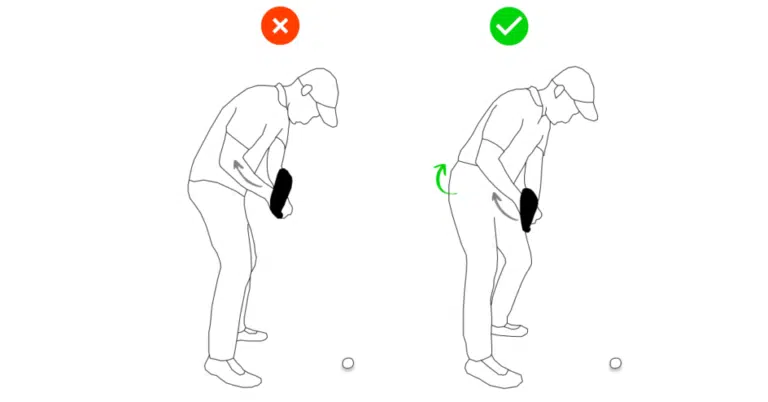
This fault causes poor sequencing and pulls, slices, and weak shots.
How It Affects Your Golf Shots
- Loss of Power and Distance
Poor hip rotation reduces the power you can generate in the downswing, leading to shorter shots. - Inconsistent Contact
A lack of hip rotation in the backswing causes thin or fat shots and poor low-point control. - Over-the-Top Downswing
The shoulders take over when the hips don’t rotate. This creates an over-the-top swing that causes slices and pulls. - Lower Back Strain
Lack of hip turn forces the lumbar spine to over-rotate, increasing the risk of pain and injury.
What Causes A Lack Of Hip Rotation In The Backswing?
- Locked Trail Knee
If the back knee stays stiff during the backswing, it prevents the lower body from rotating properly. - Excessive Knee Flex
Bending the knees too much also restricts hip movement. - Poor Weight Shift
Not shifting weight into the trail leg limits hip rotation. - Hip Slide
Sliding the hips instead of turning away from the target stops the lower body from initiating the backswing correctly. - Excess Tension In Muscles
Tight muscles at address make it hard for the hips to move. - Wide Stance
Taking an excessively wide stance locks the hips and reduces rotation.
Use GolfWiz AI Swing Analysis to pinpoint the exact technical errors holding you back.
What Other Faults Does A Lack Of Hip Rotation Cause?
- Reverse Pivot
Lack of hip rotation in the backswing makes your weight move toward the target and causes a reverse pivot. - Early Extension
If the hips can’t turn properly, they push forward during the downswing. This causes an early extension move through impact. - Over-the-Top
When the hips don’t turn, the upper body takes over. This causes a steep over the top downswing.
Swing Cues & Feels
- Trail Pocket Back
Imagine someone pulls your trail-side back pocket straight back. - Lead Knee Inward
Soften your lead knee and let it move slightly inward toward your trail leg. A rigid knee can block your hip rotation.
Swing Adaptations
- Flare Your Trail Foot
Slightly flare your trail foot outward at address. This makes it easier to rotate smoothly during the backswing. - Slightly Narrower Stance
Try a stance that is a little narrower than usual for easier rotation.. - Shorter Backswing
Focus on a shorter, controlled backswing that works with your body’s natural limits.
FAQs About A Lack of Hip Rotation in Backswing
How much wrist hinge is correct?
A good target is a 90-degree angle between your lead arm and the club shaft when your arm is parallel to the ground. It should look like an “L”.
Should I actively try to hinge my wrists?
No, it should be a passive reaction. A good body turn and the momentum of the club will cause your wrists to hinge naturally.
Does my grip affect my wrist hinge?
Absolutely. A grip that’s too much in the palm restricts wrist motion. Holding the club more in your fingers allows for a better hinge.
Can a golfer have too much wrist hinge?
Yes. Over-hinging can make it very difficult to time the release of the club, leading to wild inconsistency and a loss of control.
How can I tell if I have this issue?
The GolfWiz AI app can detect a lack of wrist hinge for you instantly. The app highlights 50+ swing errors and shows you the exact drills to fix them. Start for FREE now.
Alternate Names
- Limited Hip Turn
- Restricted Hip Coil
- Stalled Hips (in the backswing)
Final Thoughts
Limited hip rotation in the backswing reduces your distance and accuracy. You can build a powerful and consistent swing by focusing on proper technique and improving your mobility.
Use GolfWiz to pinpoint swing errors accurately and get AI-assisted drills for your swing.
Unlock your FREE AI-Powered Swing Analysis now.