
What Is Upper Body Sway In Golf?
Upper body sway is when your torso and head slide sideways, away from the target, instead of turning around your spine.
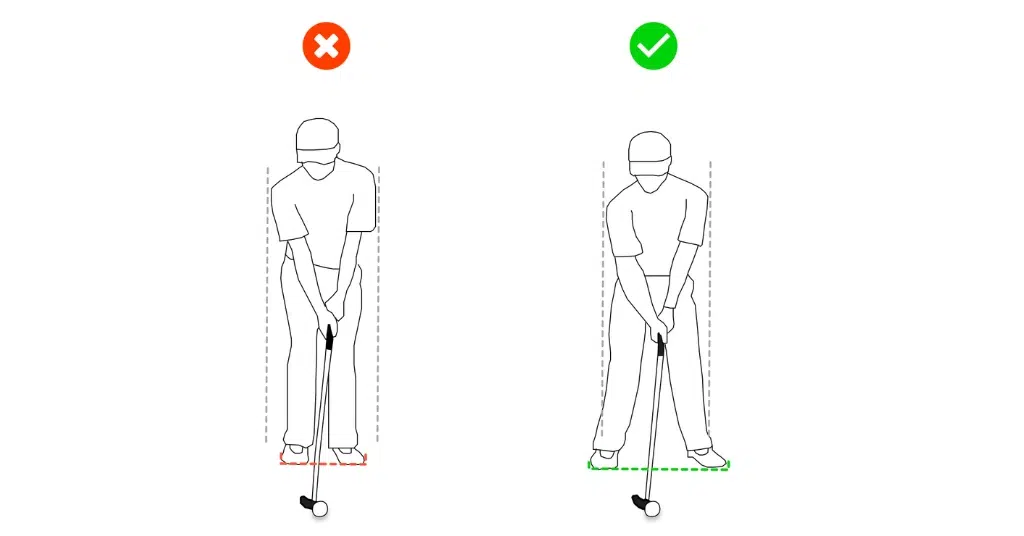
An excessively narrow stance reduces stability and balance, making it difficult to create power and maintain consistent swing mechanics.
How It Affects Your Golf Shots
- Loss of Distance
A sway limits your rotation and reduces the power you can produce. Result: shorter shots. - Inconsistent Contact
Swaying makes it difficult to make solid contact because your body isn’t stable over the ball. - Early Ground Contact
Swaying can cause chunks if your body doesn’t return to the center. - Directional Misses
Swaying makes the clubface and the swing path inconsistent at impact. This can lead to heel and toes strikes, an open or closed clubface, and poor accuracy. - Poor Balance
A sway reduces stability and makes it difficult to stay balanced through the swing.
What Causes Upper Body Sway?
- Hip Slide
A lateral hip move can pull the upper body back into a sway. - Poor Setup
Poor address positions, like leaning away from the target or having the weight on your trail foot, can cause a sway. - Unstable Lower Body
If your hips rotate without a stable lower body, your upper body sways along. - Poor Weight Shift
Having your weight on the trail side at setup can cause the upper body to sway in the backswing. - Inside Takeaway
An inside takeaway can pull the upper body back with the arms, causing a sway.
Use GolfWiz AI Swing Analysis to pinpoint the precise faults holding you back.
What Other Faults Does Upper Body Sway Cause?
- Early Extension
A sway pulls you out of position and can cause you to early extend in the downswing. - Hanging Back
A sway in the backswing makes proper weight shift difficult in the downswing.
Swing Cues & Feels
- Keep Your Head Steady
Feel your head stay stable as your body turns around the center. - Turn Inside Your Trail Leg
Let your trail hip move back rather than sideways so that you rotate within your setup. - Sternum Over the Ball
Keep your chest centered over the ball throughout the backswing.
Swing Adaptations
- Shorter Backswing
A shorter backswing makes it easier to stay centered. - Wider Stance
Standing with your feet farther apart improves stability during the swing. - Flare the Trail Foot
A slight flare helps your hip rotate more freely, reducing the tendency to sway.
FAQs About Upper Body Sway
How much wrist hinge is correct?
A good target is a 90-degree angle between your lead arm and the club shaft when your arm is parallel to the ground. It should look like an “L”.
Should I actively try to hinge my wrists?
No, it should be a passive reaction. A good body turn and the momentum of the club will cause your wrists to hinge naturally.
Does my grip affect my wrist hinge?
Absolutely. A grip that’s too much in the palm restricts wrist motion. Holding the club more in your fingers allows for a better hinge.
Can a golfer have too much wrist hinge?
Yes. Over-hinging can make it very difficult to time the release of the club, leading to wild inconsistency and a loss of control.
How can I tell if I have this issue?
The GolfWiz AI app can detect a lack of wrist hinge for you instantly. The app highlights 50+ swing errors and shows you the exact drills to fix them. Start for FREE now.
Other Names
- Leaning to the Right (for a right-handed golfer)
- Swaying Off the Ball
- Lateral Shift
Final Thoughts
A centered backswing is essential for clean and consistent ball striking. Fixing upper body sway helps you rotate with control and return the club to the ball with better precision.
Use GolfWiz to pinpoint swing errors accurately and get AI-assisted drills for your swing.
Unlock your FREE AI-Powered Swing Analysis now.