
What Is A Loss Of Spine Angle In The Backswing?
Loss of spine angle is when your upper body rises or tilts off its original posture during the backswing.
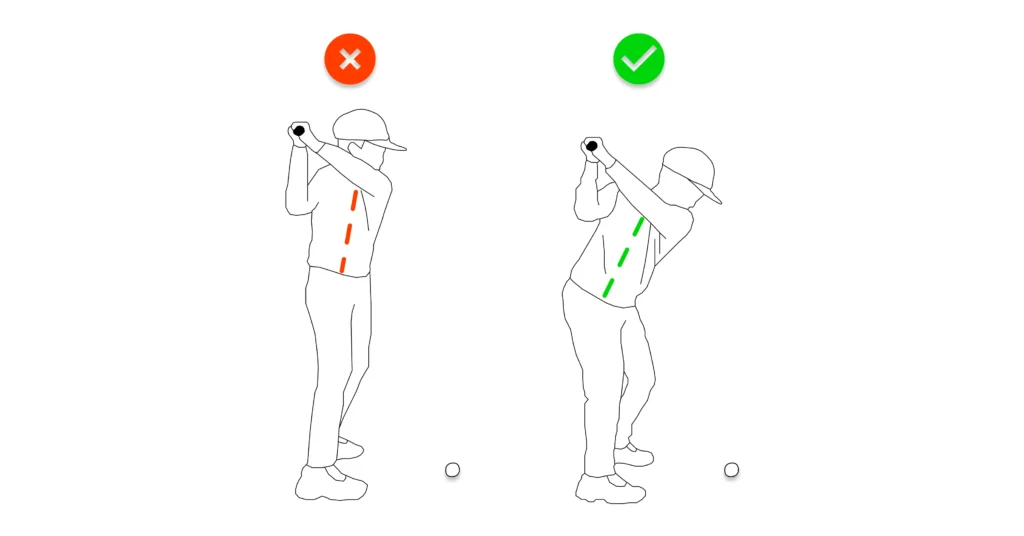
This can cause balance issues and lead to slices, fat and thin shots, or weak distance.
How It Affects Your Golf Shots
- Slices
When the spine lifts in the backswing the club reroutes steeply. This steep path cuts across the ball and creates slices. - Inconsistent Contact
Changing posture shifts your low point, which makes it easy to hit behind the ball or catch it thin. - Weak Contact
Poor posture reduces rotation and width. This decreases your swing speed and compression at impact. - Loss of Distance
Your body can’t rotate properly from an upright posture. This slows your swing and reduces power.
What Causes A Loss Of Spine Angle?
- Improper Setup
A tall setup or standing too close to the ball leaves no room to turn. This causes you to stand up at the top. - Leaning Towards the Target at Setup
Leaning towards the target at setup can make you lose the spine angle at top as a compensation. - Hip Slide In Backswing
Sliding instead of rotating can force your spine up in the backswing. - Overactive Upper Body
If the chest lifts during the backswing, you lose spine angle at the top. - Poor Hip Rotation
When the hips do not turn, the torso lifts to complete the backswing. This causes loss of spine angle. - Weak Lower Body
If the legs and hips aren’t strong enough to support the turn, the body lifts up and the spine loses its angle. - Long Backswing
A long backswing can wreck your spine angle as your arms and chest pull the body upwards. - Lack of Awareness of Posture
Many players lose spine angle without feeling it. Without awareness, the upper body can lift unknowingly.
Use GolfWiz AI Swing Analysis to pinpoint the exact technical issues holding you back.
What Other Faults Does A Loss of Spine Angle Cause?
- Early Extension
Loss of spine angle at the top can cause early extension in the downswing. - Over-the-Top Downswing
Lifting the spine often results in a steep, off-plane downswing. - Lack of Hip Rotation
Loss of spine angle at the top can prevent proper hip rotation in the downswing. - Lack of Sidebend at Impact
A tall spine makes it harder to regain proper tilt by the time you reach impact.
Swing Cues & Feels
- Coil Around Your Spine
Feel your back muscles rotate around a fixed axis. This creates a stable turn without standing up. - Turn Under the Chin
Rotate your torso under your chin instead of lifting it. This keeps your posture centered and stable during the backswing.
Swing Adaptations
- Shorter Backswing
Adapt to a shorter backswing if your upper back is tight. This helps you turn while maintaining your spine angle. - Reduce Forward Bend
Stand slightly more upright at setup. This helps maintain balance and allows you to swing without losing spine angle. - Protect Your Back
Focus on balance and a centered pivot if you feel back pain. Don’t force your spine downward to avoid injury and keep the swing efficient.
FAQs About Loss of Spine Angle
How do I know if I’m losing my spine angle?
The GolfWiz AI app can detect a loss of spine angle in your backswing instantly. The app highlights 50+ swing errors and shows you the exact drills to fix them. Start for FREE now.
Does losing spine angle always cause a slice?
Often, because it steepens the downswing. But some golfers hook the ball when they lose their posture.
Is losing spine angle the same as early extension?
No. Loss of spine angle happens in the backswing, while early extension happens in the downswing. They often appear together, but are separate faults.
Can improved mobility help fix this?
Yes. Hip and thoracic mobility improve your ability to turn without lifting your posture.
How long does it take to fix?
Many golfers improve within a couple of weeks with posture checkpoints. Strength and mobility improvements speed up the change.
Alternate Names
- Loss of Posture at the Top
- Standing Up in the Backswing
- Chest Lift in the Backswing
Final Thoughts
Loss of spine angle limits your rotation, consistency and power. Limited mobility or overactive upper-body movement can lead to this problem.
Use GolfWiz to pinpoint swing errors accurately and get AI-assisted drills for your swing.
Unlock your FREE AI-Powered Swing Analysis now.