
What Is Casting In The Downswing?
Casting in the downswing is the early release of the wrist angle from the top. It prevents you from maintaining the lag between the lead arm and shaft until your hands reach the impact zone.
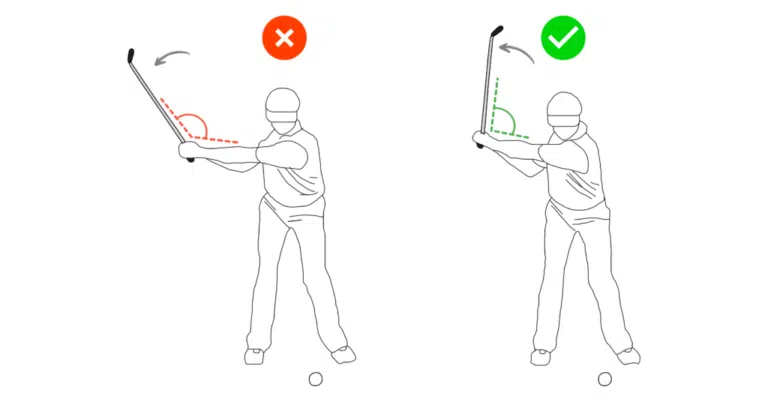
Casting in the downswing causes inconsistent contact, push slices or slices, and high, weak shots to the right.
How It Affects Your Golf Shots
- Loss of Distance
Casting causes your clubhead speed to peak before it even reaches the ball, so your distance suffers. - Inconsistent Contact
Casting shifts the swing’s low point for every shot and makes contact inconsistent. - Excessive Height and Spin
An early release adds unwanted loft to the clubface at impact. This makes distance control difficult as the launch and spin are inconsistent.
“Hip rotational velocity peaks during the downswing phase of the golf swing.” (source) - Over-The-Top Move
Casting often creates an over-the-top swing path that is too steep and outside-to-in, the key cause of a slice.
What Causes Casting in Downswing?
- Starting The Downswing With Hands
If your arms and shoulders fire before your lower body, your wrists will be forced to unhinge early. - Weak Grip
A weak grip can leave the clubface open. To compensate, you may subconsciously cast the club to square the clubface. - Trying To Lift The Ball
Many golfers instinctively try to scoop the ball into the air. This promotes an early wrist release and casting in the downswing. - Over-Swinging
Golfers with a long backswing usually compensate by casting the club in the downswing. - Across-The-Line Backswing
You need to cast the club outward to compensate for an across-the-line or long backswing. - Lack of Shaft Lean Awareness
Proper impact requires forward shaft lean. You may throw the club out and cast in the downswing if you’re unaware of this.
Use GolfWiz’s AI Swing Analysis to pinpoint the exact swiing faults holding you back.
What Other Faults Does Casting Cause?
- Early Extension
Casting may force you to early extend in the downswing. - Chicken Wing Follow-through
Casting removes all lag from the swing and may cause your lead arm to bend in a chicken wing.
Swing Cues & Feels
- Shift Weight to Lead Foot
Focus on starting the downswing by shifting your weight to your lead foot. - Pull the Handle Down
Think about pulling the grip end of the club down toward the ball. - Hands as Passive Passengers
Let your hips move first and create space for your arms to drop.
Swing Adaptations
- Flare Your Lead Foot
If you have tight hips, flare your lead foot outward 20–30 degrees at setup to create more room for rotation. - Stronger Grip
If you lack wrist strength, adopt a slightly stronger grip by turning your lead hand more on top of the club.
FAQs About Casting in Golf Swing
How do I know if I’m casting without a coach?
The GolfWiz AI app can identify casting for you instantly. The app highlights 50+ swing errors and shows you the exact drills to fix them. Start for FREE now.
Can casting cause a hook?
While casting is more often linked to a slice, it can also cause a hook if you shut the clubface.
Does a heavy club make casting worse?
It can. If a club is too heavy to control it can lead to an early release as your body struggles to manage the weight.
Is it possible to have too much lag?
For amateur golfers it’s very rare. While it is theoretically possible, you would benefit from feeling more lag, not less.
How long does it take to fix casting?
It varies for every golfer. Using drills to build new muscle memory can help you see changes in a few weeks.
Alternate Names
- Hitting from the Top
- Casting from the Top
- Early Release
- Throwing the Club
- Dumping the Lag
- Breaking the Angle
Final Thoughts
Casting costs you both distance and accuracy. Low thoracic mobility, weak core and forearm muscles can encourage casting. It can also be a result of technical errors like over-swinging.
Use GolfWiz to pinpoint swing errors accurately and get AI-assisted drills for your swing.
Unlock your FREE AI-Powered Swing Analysis now.