
What Is Flipping At Impact?
Flipping at impact is when the trail hand overtakes the lead hand too early, leading to a push, push slice, or a high, weak shot to the right.
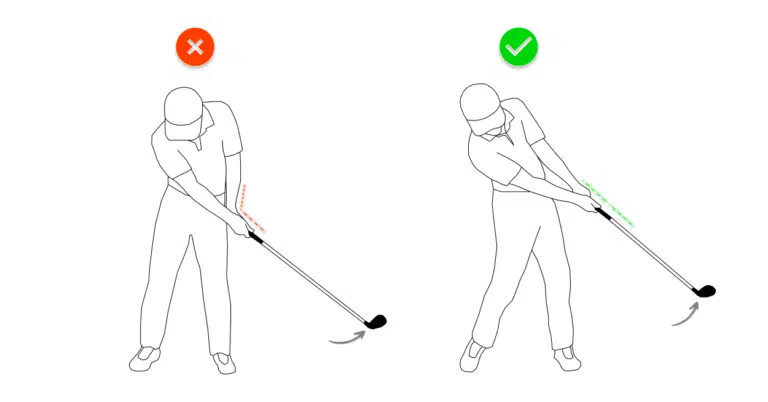
“It adds loft to the face of the club and as a result we see a loss of power and consistency.” Titleist Performance Institute (TPI)
How It Affects Your Golf Shots
- Loss of Distance
You lose power because flipping adds loft and reduces compression. - Inconsistent Contact
Flipping often causes you to hit the ball fat or thin as it moves your swing’s low point behind the ball. - Two-Way Misses
Your hands lose control when you flip the club. This can lead to both hooks and pushed shots.
What Causes Flipping At Impact?
- Weak Grip
Holding the club incorrectly makes it hard to square the face, forcing your hands to flip at the last moment. - Open Clubface
An open clubface on the downswing makes your hands flip subconsciously to avoid a slice. - Lack Of Rotation
Lack of hip rotation in the downswing causes your arms to take over and the hands to flip. - Casting
Releasing wrist angles too early from the top of the swing makes the clubhead reach the ball first. - Poor Weight Shift
Staying on your trail leg forces your hands to flip to get the ball in the air. - Over-The-Top Downswing
Swinging the club on a steep over-the-top plane forces your hands to flip.
Use GolfWiz AI Swing Analysis to pinpoint the exact technical errors holding you back.
What Other Faults Does Flipping Cause?
- Chicken Wing Follow-through
Flipping at impact can cause the lead elbow to bend into a chicken wing position at the finish.
Swing Cues & Feels
- Cover the Ball
Keep your chest over the ball through impact. This prevents standing up and flipping. - Lead with the Handle
Pull the club’s butt-end toward the target through impact to make sure your hands lead the clubhead. - Flat Lead Wrist
At impact, your lead wrist should feel flat. Press the back of your lead hand toward the target. - Squeeze a Ball
Place a soft ball between your forearms and make half-swings. If you flip, the ball will drop.
Swing Adaptations
- Shorter Backswing
Shorten and make your backswing slightly more upright if your rotation is limited. - Stronger Grip
Strengthen your grip (roll the lead hand more on top of the club) to help keep the clubface square. A strong grip reduces last-second hand flipping. - Flexible Shafts
Consider using clubs with more flexible shafts. For example, try “Regular” flex if you’re currently playing “Stiff” shafts. A flexible shaft makes loading and releasing the club easier.
FAQs About Flipping at Impact
Why does my flip get worse with my driver?
Typically because the ball is teed up, which can subconsciously encourage a scooping or upward hitting motion.
Can my ball position cause me to flip?
Yes. If the ball is too far forward in your stance, your body may not be able to rotate enough to get to it, forcing your hands to flip to reach it.
Is it possible to flip and still hit a good shot?
It’s an unreliable way to play. Relying on a flip makes consistency nearly impossible.
Can I detect flipping on my own?
Absolutely. But the GolfWiz AI app can detect flipping for you instantly. The app highlights 50+ swing faults and shows you the exact drills to fix them. Start for FREE now.
Will fixing my flip feel weird at first?
Yes. A proper impact position with forward shaft lean will feel very different, almost like you’re going to hit the ball low and to the right (for a righty).
Also Known As
- Scooping
- Early Release
- Left Wrist Breakdown
Final Thoughts
Flipping at impact reduces your power and consistency. Focus on root causes like grip, rotation, and sequencing to fix it.
Use GolfWiz to pinpoint swing errors accurately and get AI-assisted drills for your swing.
Unlock your FREE AI-Powered Swing Analysis now.